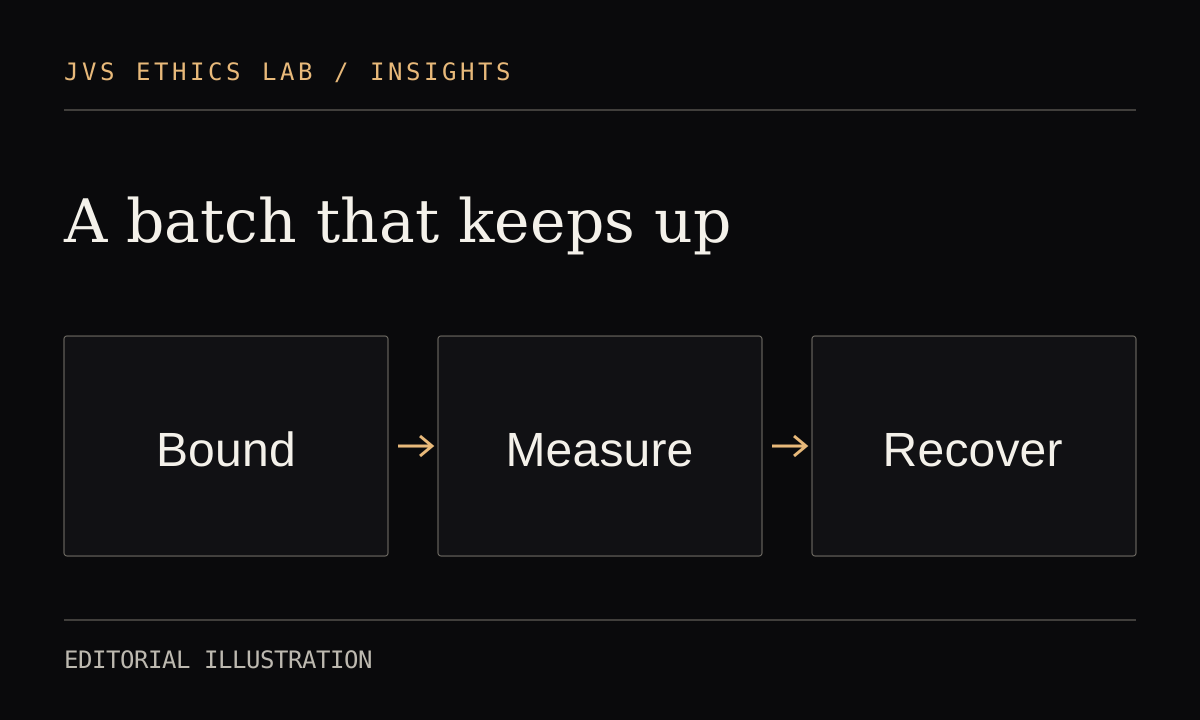
A scheduled workload should be assessed against the interval the operation requires. When a cycle is still running as the next one becomes due, the design question is bigger than “can we make this loop faster?” It includes overlap, contention, failure handling and what the business knows about unfinished work.
Establish the baseline
Record the input volume, duration, operating environment, time of day and concurrent work. Separate time spent waiting on another system from time spent processing data. Use the same workload definition when comparing a change, and keep a record of failures rather than reporting only the fastest successful run.
In the founder’s device-monitoring account, the corrected figures are approximately 20,000 devices and processing time reduced from over five minutes to under one minute. They are founder-reported. The measurement window and operating conditions remain unestablished, so the case does not publish a derived percentage or an independently audited benchmark.
Control the amount of work in flight
A hypothetical processor can divide work into bounded batches and limit the number running at once. That limit should be considered alongside database connections, query behaviour, downstream capacity and the support team’s ability to recover work. A large thread count can move the bottleneck instead of removing it.
Java’s ThreadPoolExecutor documentation explains the interaction between pool sizes, queue choice and rejection behaviour. It is a technical reference for a possible design, not a claim that this specific API was used in the founder’s historical implementation.
Separate different workload behaviour
Work that routinely waits or fails may need a different queue, timeout or review path from ordinary records. In a fictional monitoring design, unavailable devices should not make it impossible to understand the progress of available-device work. The specific separation should follow observed behaviour and the required result, rather than a blanket rule to create more queues.
Design recovery and prove the result
Decide how a batch is identified, when it is complete and how an interrupted item can be retried without repeating a consequential action. Make unfinished work visible. Test a failed item, a stopped worker and a rerun of a partly completed batch.
Compare the revised duration and exception behaviour under agreed conditions. The result should tell the operator whether the workload meets its required cadence and what happens when it does not. Capacity claims need representative evidence, not a single local execution.
Performance & Modernisation within Architecture Advisory can examine that operating constraint before a larger rewrite. Business Automation addresses the surrounding workflow and ownership.