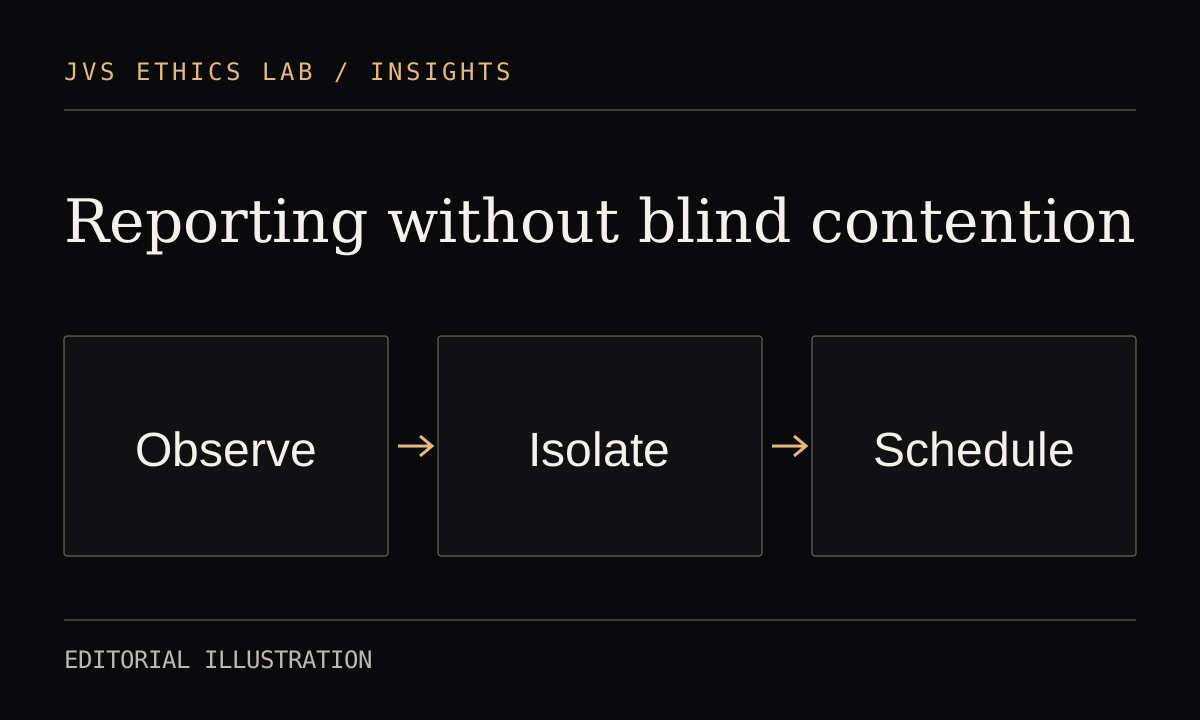
Moving a slow report to midnight may hide an operating symptom without explaining it. Before changing a schedule, establish what the report needs to do, how fresh the result must be and which other workloads are active during its execution.
Separate duration from waiting
A hypothetical overnight report might spend time doing expensive query work, waiting for another transaction or transferring results. Those are different constraints. Capture timings around meaningful stages and inspect the database evidence for the relevant period. A late final file alone cannot identify the bottleneck.
PostgreSQL’s Viewing Locks documentation describes using lock information with activity information to examine waiting and blocking. Access to operational diagnostics should be scoped and reviewed; collecting a production trace is not a reason to copy customer data into a public report.
Define the freshness requirement
Ask the report owner when the information is used and what a stale result would change. An operations dashboard, a month-end financial view and an archived management report can have different requirements. “Real time” is not a useful default when nobody has defined the operating consequence.
For a fictional daily summary, it may be acceptable to produce a stable snapshot after an agreed cutoff. That is an option to assess, not a promise that snapshotting or a cache is suitable for every workload.
Compare interventions
Possible investigations include query plans, repeated work, workload overlap, transaction duration and the way results are refreshed. If a cache is considered, specify its source, invalidation or refresh process, allowed age and the behaviour when refreshing fails. A faster stale answer is not automatically the required answer.
Changing the schedule may be appropriate after these dependencies are understood. Record the owner of the schedule and the recovery path for a missed run. Avoid relying on an undocumented job that only one person knows how to restart.
Make the outcome verifiable
Agree a baseline period and compare duration, freshness, failures and the effect on other work after the change. Include slow or failed executions. If other database or infrastructure changes occurred at the same time, record them rather than assigning all improvement to one intervention.
This guide is an illustrative diagnostic approach. It is not an overnight-reporting case study or a claim that the founder implemented a particular cache. Those project details still need confirmation.
Automation Discovery can map the report’s surrounding process. Architecture Advisory can assess the performance constraint. The monitoring experience account shows a separate, founder-reported processing intervention.